skip to main |
skip to sidebar
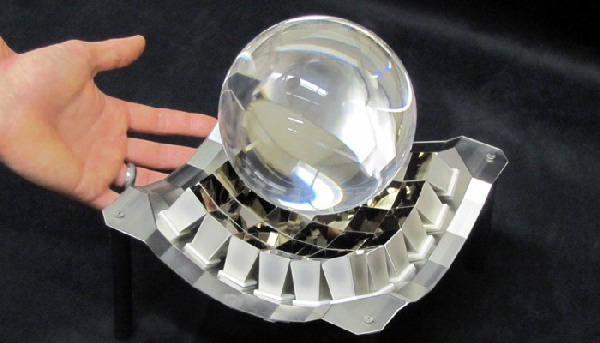
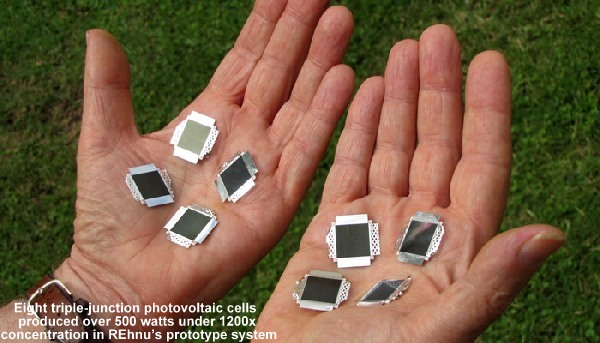
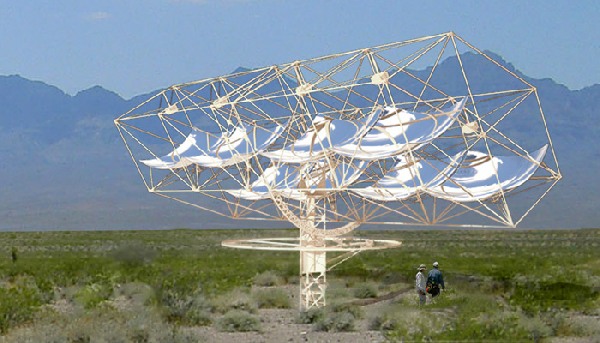
A University of Arizona engineering team led by Roger Angel has designed a new type of solar concentrator that uses half the area of solar (PV) cells used by other optical devices and delivers a light output/concentration that is over 1000 times more concentrated before it even hits the cells. This comes as a result of a broader goal to make solar energy cost competitive with fossil fuels (target = 1$/W) without the “need for government subsidization.”
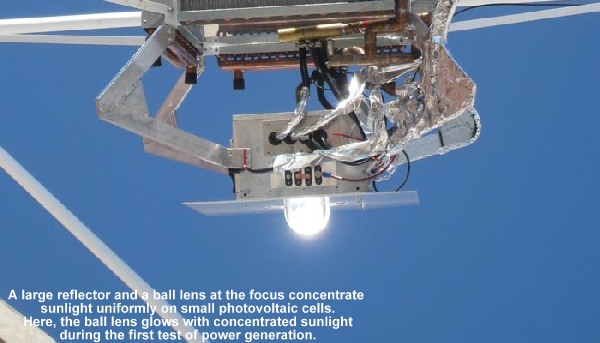
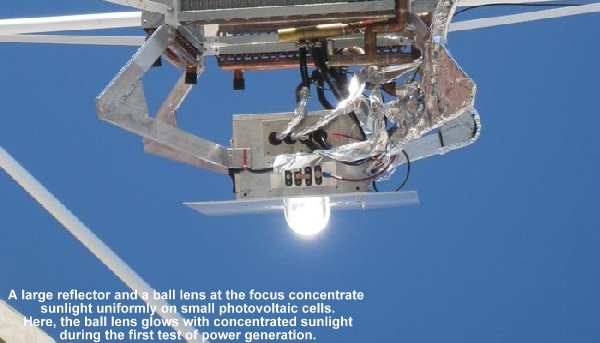
Eight dish reflectors and their associated optics and photovoltaics as well as cooling and tracking components are all integrated into a space frame structure. It was constructed in the lightest possible way using lightweight high strength low alloy steel in a mechanically efficient framework.


 EMail Feed
 Twitter


8 comments:
What wind speed can in withstand?
1$/W?! If this means $1 per watt we are in trouble. Average end user energy prices are around 8-15 cents per kilowatt. I assume this is a typo and it means 1 cent per kilowatt.
I believe its the cost of the generator, not the energy itself. They're shooting for $1000 for a 1kW generator, for example.
That is 8-15 cents per kW/h. They might be talking about the initial cost investment in the system and not a recurring cost. I.e. a 1000 watt system might cost $1000.
I'm guessing they $1/W to build. Energy prices are 8-15 cents per kWh, that includes time. If you get 5 cents per kWh, you recover your initial cost after 20 kh, roughly 6 years (~10 hours per day).
Yeah, $1/watt is the construction cost. So, let's convert this to Kwh. Say we build a 1000 watt machine in a sunny place and get 6 hours of sunshine. We have spent $1000 and will now produce 6Kwh of electricity per day for the life of the machine. Let's say this thing lasts for 25 years (a standard time frame in the solar industry).
So, 365 days/year * 25 years * 6 Kwh/day = 54750 Kwh over the life of the machine. Since we paid $1000 for it, that works out to 1.8 cents per Kwh.
That price would make electricity much cheaper than coal. That's why this $1/watt is such a huge goal for the solar industry. If they can make it there, they won't need subsidies.
Noble goal, I hope it works out.
That being said, they specifically mention "without the need for government subsidies" which is a ridiculous statement. Every aspect of our commercial lives is subsidized by the government, whether it's research to develop new technologies, delivery of items to site, enforcement of safety standards so that insurance companies will still sell you a policy on your house when you have one. These are all forms of subsidies.
I do agree that cost effective solar should not require getting tax breaks for installing the system, but realize that the basic technology you're talking about here has already been subsidized.
w0w...great if that so!
I hope we can see them in the market and use as an application.
Post a Comment